Sociolinguistic Interview
Out of date dictionaries- with native speakers from UK/USA/Australia!
 Play video
Dr. Geoff Lindsey interviews young native speakers across the USA, UK, and Australia to find how pronunciations of common words have been changing/are changed from standard dictionary phonetic transcriptions. This is an example of a diachronic approach to linguistics- comparing phonology in the past to the present to look at an evolution of pronunciation.
Fandom and Language Use for English Language Learners
A study discussing how the participants who were English language learners used fandom and fandom language to explore and shape their online identities.
CALIFORNIA - You can fry if you want to
 Play video
short interviews about perception of vocal fry on UC Berkeley. Interesting metapragmatic commentary about both the perception of creaky voice and individuals' (mostly feminine-presenting people) perceptions and insecurities around the way they speak.
PNG in NYC - Tok Pisin
 Play video
Ilona Rayan, now a Long Islander, was born in Papua New Guinea, one of the world's most linguistically diverse places. She and her mother are the only two speakers of Tawala in New York. Here speaking PNG's national language, the English-based creole Tok Pisin, she describes the language situation in the country and in her very multilingual family.
Turkish Whistle Language
 Play video
For three centuries, farmers living in the remote mountains of northern Turkey have communicated great distances by whistling. It’s a language called kuş dili that is still used to this day, though fewer people are learning it in the age of the cell phone. Muazzez Köçek lives in Kuşköy, and she is the best whistler in her village. Muazzez shows us how she uses varied pitch frequencies and melodies to translate Turkish vocabulary into whistles with meaning.

Philippine English vs. Australian English
 Play video
"Philippine English vs. Australian English" is a funny YouTube video by a Filipino husband and his Australian wife illustrating the differences between the two different dialects of English. By comparing different words and terms between the two dialects, the differences are sometimes profound, incomprehensible, and often very funny!
Mitchell on Manners
 Play video
This is the first of a four part series exploring linguistic interactions surrounding manners and their culturally-defined meanings. The program describes how cultural norms determine what is considered polite or rude, such as what questions you can ask another person and how you should address people who are older or younger than you. Manners in Western Europe are explained to be standards set by the ruling and higher class members of society who sought to further establish their superiority over the lower classes, who couldn't afford eight different knives for a singular meal. The discussants also speak about a possible delineation between "etiquette" and "manners." The later portions of the program discuss expectations of social interaction, such as not constantly looking at one's phone while accompanied by another person and to ensure that there are no awkward pauses during a conversation.
Berenstain Bears Reconnect Sioux To Native Language
Berenstain Bears cartoons help teach and revive the Lakota language. [Published on 09-26-2006]
XKCD: Appropriate Term
A XKCD comic highlighting the formality continuum of style-shifting.
Mountain Talk
 Play video
An excerpt from the film "Mountain Talk," on Applachian English in North Carolina, from the the North Carolina Language and Life Project
(r) in New York City English
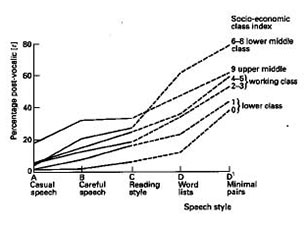 (Enlarge image)
The classic graph from Labov (1966) showing stratification by socioeconomic class and speaker style for coda r vocalization in New York City English